If you’ve started looking into Early Years education for your child in Bangkok, you’ve probably come across a confusing mix of terms: Nursery, Kindergarten, Reception, K1, K2, Anuban 1 and Anuban 2. Different countries, and schools following different curriculums in the same country, use different words for very similar stages of early childhood. If your family has moved between education systems, the picture becomes more confusing still.
At St. Andrews International School, Sathorn, the Early Years journey runs across three stages: Nursery, from age 2; Kindergarten (K1), from age 3, equivalent to Thai Anuban 1; and Reception (K2), from age 4, equivalent to Thai Anuban 2. These stages are not separate systems bolted together. They form one continuous journey of development, in which each year builds gently on the one before it, with children gradually taking on more independence, more structure and more of the skills they will need for Year 1 and beyond.
This article sets out what each stage actually involves, why the terminology can feel so inconsistent between countries and what really matters for your child’s development along the way.
Nursery, Kindergarten and Reception at a glance
| Stage | Typical age | Thai equivalent | Where it sits |
|---|---|---|---|
| Nursery | From 2 years | Triyam Anuban | First setting outside the family home |
| Kindergarten (K1) | From 3 years | Anuban 1 | Second year of Early Years |
| Reception (K2) | From 4 years | Anuban 2 | Final year of Early Years, before Year 1 |
Children move through these stages according to their age, based on their date of birth relative to the school’s cut-off dates, rather than a stage being something a family chooses freely. A child’s birthday determines which class they join in a given academic year according to the school’s age and admissions criteria.
Why the words don’t always match up
England, Thailand and international schools each use slightly different vocabulary for what is broadly the same stage of childhood. That is where most of the confusion starts.
In England, Reception is normally the first year of primary school, rather than a stage that comes after “kindergarten.” “Kindergarten” is not an official year-group name within the English education system; it doesn’t appear in England’s Department for Education guidance the way Nursery, Reception and Year 1 do.
In Thailand, and across many international schools, “Kindergarten” is commonly used as a broader umbrella term for the years before Year 1, often split into K1 and K2, aligning neatly with the Thai Anuban 1 and Anuban 2 years. Because of this, you’ll sometimes see Reception described locally as a child’s “second year of kindergarten.” That makes complete sense within a Thai or international frame of reference, but it can be misleading if you’re used to English terminology, where Reception marks the start of primary school itself, not a continuation of a separate kindergarten stage.
At St. Andrews Sathorn, this is resolved by using both sets of labels together: Kindergarten refers to K1 and Reception refers to K2. You may find yourself comparing notes with a Thai Anuban 1 parent, a Reception parent from a UK state school, or another international school family in Bangkok using different labels again. In each case your child is in the same broad stage of development, even if the name on the classroom door looks different.
One continuous journey, not three separate systems
Nursery, Kindergarten and Reception are not three unrelated stages with hard lines between them. They form one gradual arc of development, broadly following the structure of England’s Early Years Foundation Stage (EYFS), the framework that guides children’s learning and development from birth to age five. Underneath the different classroom names, the same broad areas of development run all the way through: how a child communicates, how they relate to others and manage their feelings, how their bodies grow more capable and how they begin to make sense of literacy, numbers and the world around them.
What changes as children move from Nursery through Kindergarten and into Reception isn’t the fundamentals; it’s the balance. Younger children spend much of their time learning through play and exploration. As they get older, adults gradually introduce more structured and guided activities, without losing the importance of play.
Nursery: from age 2
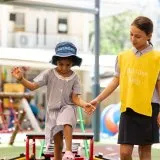
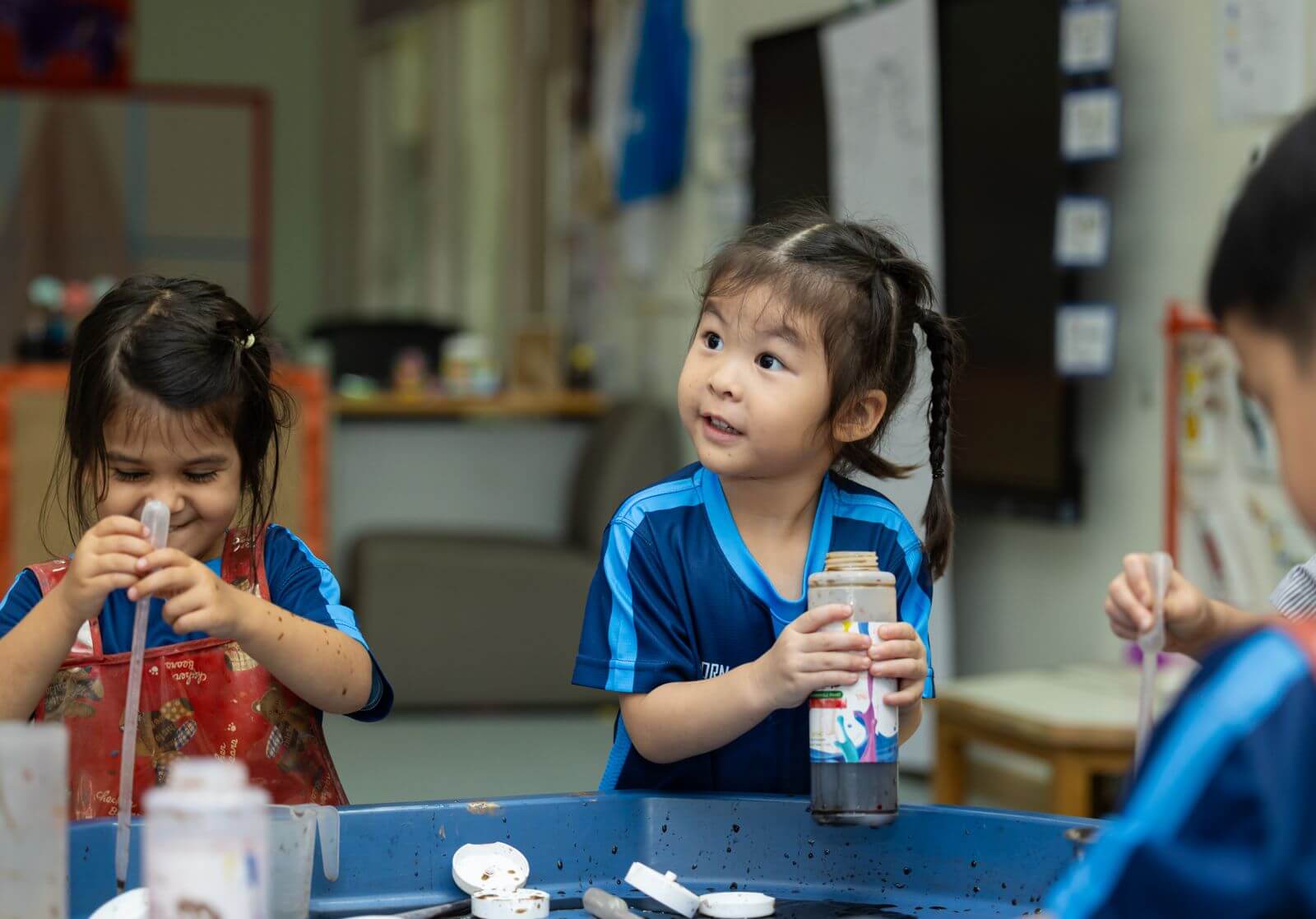
Nursery is often a child’s first experience of a group setting outside their immediate family. At this age, the focus is on helping children feel safe and secure away from a parent or carer, building their confidence to explore and giving them rich sensory and physical experiences: sand, water, messy play, movement, songs and stories. Communication at this stage might be single words, gestures or short phrases, and a large part of the Nursery year is simply learning how to be part of a small community: sharing, taking turns and getting used to a daily rhythm.
A typical Nursery child might be learning to follow a simple daily routine, join in with a song or story as part of a group and explore sand, water or paint with growing confidence, all while starting to communicate what they want or need through words, gestures or pointing. Progress at this stage is measured in small steps, and settling in happily is itself an achievement.
Kindergarten (K1): from age 3
By Kindergarten, most children are more settled into the rhythm of school life. Play remains the primary way children learn, but it becomes a little more sustained and complex: longer periods of concentration, more elaborate role play and more group activities that involve cooperating with other children rather than simply playing alongside them. Language usually develops quickly during this year, with children moving from short phrases to fuller sentences and simple conversations. Numbers, letters, shapes and colours appear naturally through games, songs and stories, rather than through formal seated lessons.
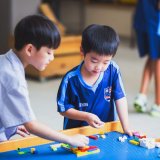
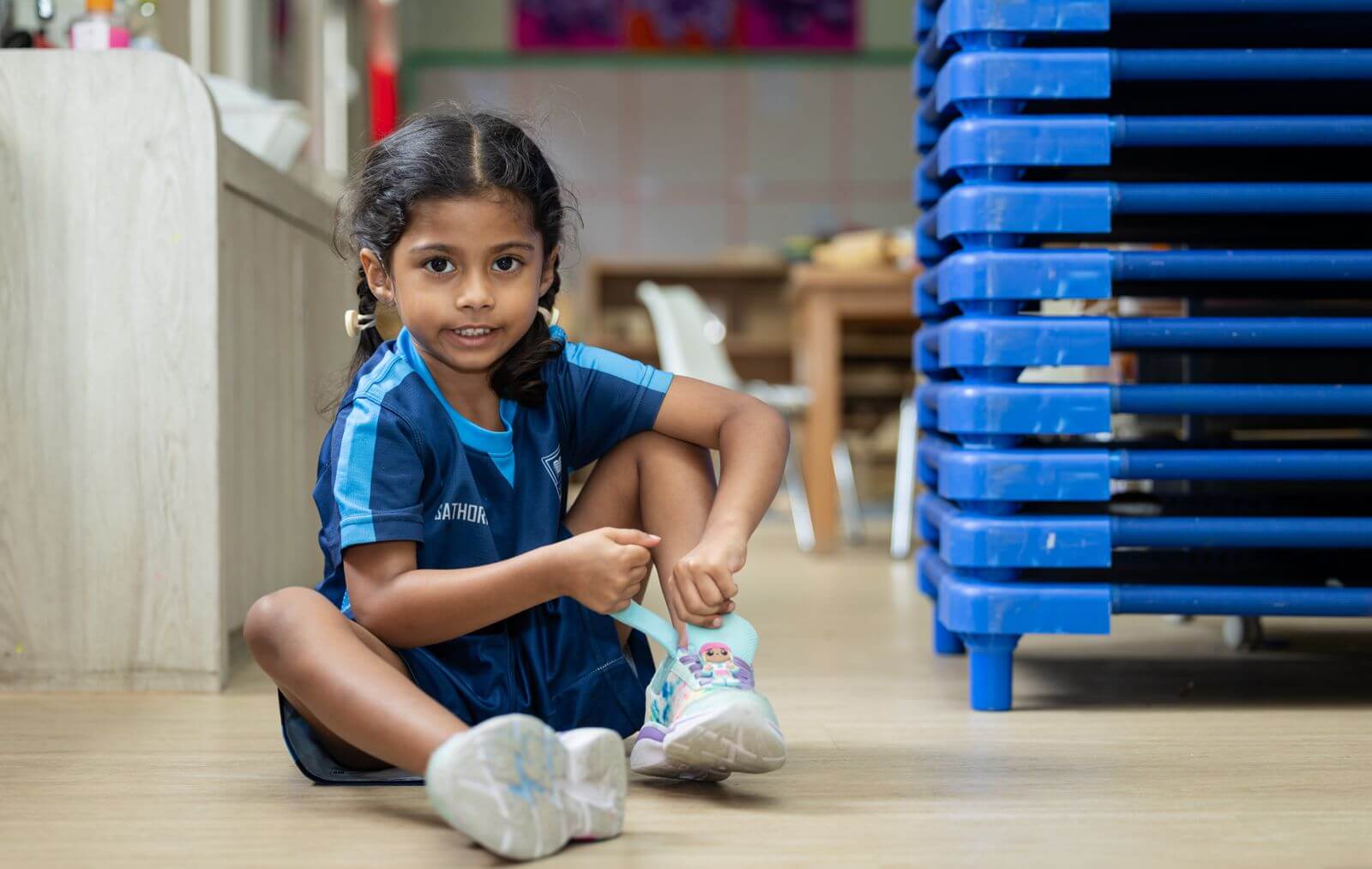
This is often the year when children start to move from playing alongside others towards playing and working with them: sharing a role-play game, helping to tidy away together or taking turns in a simple board game. Parents may also notice their child becoming more capable of managing their own belongings and following short routines, such as putting on their own shoes or hanging up a bag, with less reminding than before.
Reception (K2): from age 4
Reception is the final Early Years stage before Year 1, and it acts as a bridge. Children are still learning predominantly through play, but there’s a gradual increase in adult-guided activities woven through the day: short, focused group times, more structured tasks alongside free play and growing opportunities to work with a partner or in a small group towards a shared goal. This is the year when many of the building blocks for more formal learning – listening to stories with attention, recognising patterns in sounds and print, counting and comparing quantities – begin to come together, always through activities that still feel like play to the child.
Compared with Kindergarten, parents will often notice their child concentrating for longer on a single activity, taking part in more purposeful adult-guided tasks alongside their play and showing clearer early literacy and numeracy foundations, such as recognising familiar words or comparing quantities. Independence also becomes more visible day to day, from managing their own belongings to following a short sequence of instructions without needing each step repeated.
The three prime areas: how children communicate, relate and move
Three areas of the EYFS are described as “prime”. They underpin everything else a child learns, and they receive particular attention throughout Nursery, Kindergarten and Reception.
Communication and language develops from early babbling and gesturing through to full conversations, storytelling and following more complex instructions. Adults support this through conversation, stories, songs, modelling language and giving children plenty of opportunities to express themselves.
Personal, social and emotional development covers how a child copes with being away from home, how they form friendships, how they begin to recognise and manage their own feelings and how they learn to consider other people’s needs. This is arguably the area parents notice developing most visibly between Nursery and Reception: parents may see a child who initially needed considerable reassurance when separating from them gradually become more confident about arriving at school, joining activities and greeting friends independently.
Physical development moves from large, whole-body movement such as running, climbing and balancing towards the finer motor control needed for holding a pencil, using scissors and manipulating small objects. This fine motor progress matters enormously for later writing, and it’s one of the reasons Early Years settings put so much emphasis on activities like play dough, threading, cutting and drawing, well before any formal handwriting is expected.
Beyond the prime areas: literacy, numeracy and the wider world
Four further areas, described as “specific areas”, build on that foundation: literacy, mathematics, understanding the world and expressive arts and design. They develop through the same play-based approach and become more prominent as children move towards Reception.
Early literacy in these years is about far more than letters. It includes listening to and enjoying stories, noticing rhyme and rhythm in songs, understanding that print carries meaning and building the vocabulary and spoken language skills that underpin reading later on. Early mark-making, whether that’s a scribble, a drawing or an attempt at their own name, is part of the same journey towards writing. Early mathematics, in the same way, is built through counting songs, comparing sizes, sorting objects and noticing patterns, long before children encounter a worksheet.
Growing independence, gradually
Independence develops steadily across all three stages. In Nursery, this might mean a child learning to put on their own shoes or use the toilet with less support. By Kindergarten, it often extends further: managing their own belongings, following an activity through to completion and beginning to resolve small disagreements with a friend. By Reception, most children are managing a good deal of their own self-care, following a sequence of instructions without needing each step repeated and taking pride in completing a task independently. For a smooth start to Year 1, this matters just as much as any academic skill.
How learning becomes more structured over time
Structure does not arrive all at once in Reception. It builds gradually across all three stages. In Nursery, much of the day is shaped around child-initiated play, with adults following the child’s interests. In Kindergarten, short, focused group times start to appear alongside free play, perhaps a story time, a simple counting activity or a group discussion. By Reception, children are used to moving between free-flow play and more focused adult-guided sessions, and to sitting and concentrating for a little longer at a stretch. Play remains central throughout. Reception is not a scaled-down version of formal schooling; it is the point where play and adult-guided learning sit most comfortably together, in preparation for what comes next.
How Reception helps prepare children for Year 1
Year 1 tends to ask more of children in terms of sitting for longer periods, following multi-step instructions and working within a more defined timetable. Reception is designed to make that step feel natural rather than sudden. In England, the EYFS framework describes seven areas of learning that run through all three years, and sets out the knowledge and skills most children are generally expected to have developed by the end of Reception, often referred to as the Early Learning Goals. These act as a general description of typical development at that age, not a checklist a child needs to complete perfectly before moving on.
Individual schools may use different approaches to areas such as phonics, early reading and writing, so parents can ask the Early Years team how these are introduced within their child’s year group.
What “school readiness” actually means
“School readiness” is a phrase that causes a lot of unnecessary parental anxiety, often because it’s assumed to mean academic readiness: can my child count to twenty, do they know their letters, can they write their name. Most Early Years professionals describe readiness quite differently. It’s about whether a child can separate from a parent without excessive distress, follow simple instructions, engage with other children, manage their own basic needs and approach new experiences with curiosity rather than fear. These social, emotional and behavioural foundations are an important part of a confident start to school and should not be overlooked in favour of individual academic milestones.
Why children don’t need to arrive already reading or writing
Children are not expected to arrive at Nursery, Kindergarten or even Reception already reading or writing. Formal reading and writing instruction is introduced progressively and builds on foundations such as spoken vocabulary, listening skills, awareness of rhyme and sound and fine motor control, all of which take time to develop and vary naturally from child to child. In an international school community like Bangkok’s, where many children are growing up bilingual or trilingual and moving between languages at home and at school, this natural variation is even more pronounced, and entirely normal. A wide range of starting points within the same class is expected, not a cause for concern.
What parents should consider when their child starts Early Years
A few practical points to keep in mind as your child begins:
- Focus on your child’s own pace rather than comparing them with siblings, cousins or classmates. The age range within a single year group, plus differences in home language, means genuine variation is completely normal.
- Keep home routines reasonably consistent with what’s happening at school, particularly around things like toileting, mealtimes and rest, so your child isn’t managing two very different sets of expectations at once.
- Talk about school positively and matter-of-factly, and be patient with settling-in periods. Some children take to a new stage within days, others need several weeks.
- Stay in regular contact with your child’s teacher. They will usually be able to tell you far more about how your child is actually doing, socially and emotionally as well as academically, than any single milestone can.
- Remember that play is not a break from learning in these years. It is how learning happens, at every stage from Nursery through to Reception.
From Nursery to Reception: One Early Years Journey
Seen as one developmental journey rather than three separate systems with confusing names, Nursery, Kindergarten and Reception become much easier to make sense of. If you’d like to see how this looks in practice, the Early Years team at St. Andrews International School, Sathorn would be glad to talk you through the stages in more detail. You’re welcome to explore the Early Years Foundation Stage at St. Andrews Sathorn or get in touch with the admissions team to arrange a visit and see the Nursery, Kindergarten and Reception classrooms for yourself.